Laser lights (moving head)
9 products
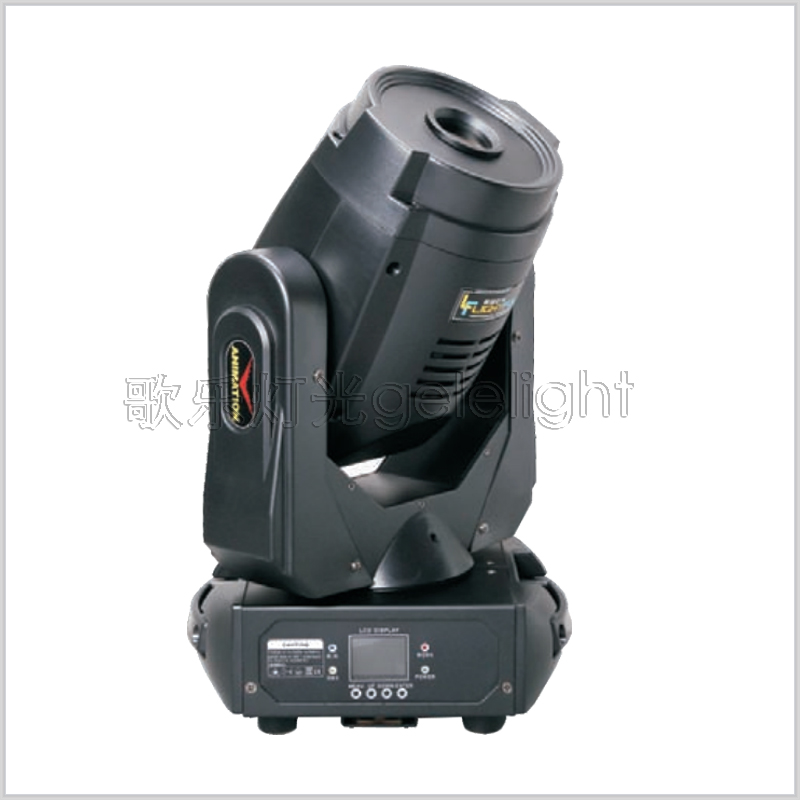
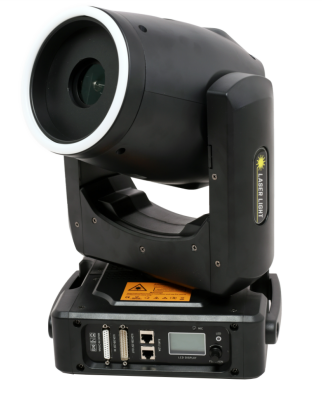
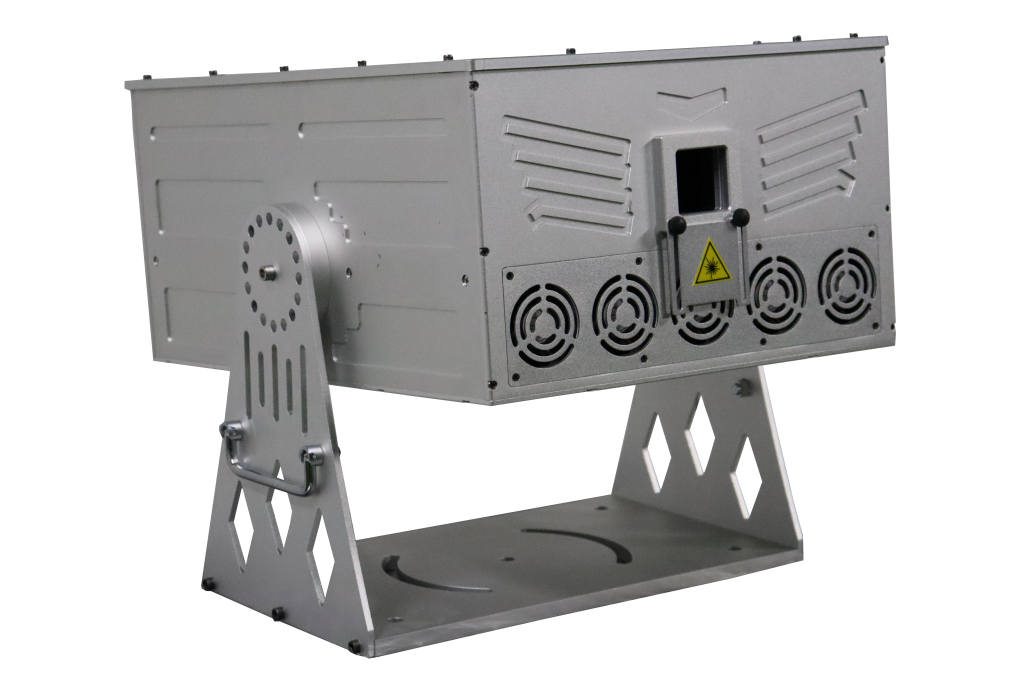
A moving-head laser light is one with X/Y motors inside the housing: the beam and the patterns are steered by the fixture itself, so one unit can cover a whole surface. Its sibling line, laser lights (non-moving head), projects in a fixed direction and covers a surface by using several units instead. Which one you want comes down to two questions: how large the surface is, and how much power the site can actually supply. Every figure on this page is read from our own spec sheet and can be checked line by line.
1. What the moving-head version adds
It adds the motor set. On our own spec sheet the moving-head models we list state 540° on the X axis and 270° on the Y axis, with an optical angle of around ±30°. Several different models carry the same figures, so the reading is consistent across the line.
Adding that mechanism moves both weight and power. On our own spec sheet the moving-head models run from 8.5 kg to 13 kg net, where a small fixed fixture can be 1.6 kg. That changes how you mount it: a moving-head unit has to be rigged for a moving load, not for its static weight.
2. The wattage in the model name is laser output, not power draw
This is the easiest thing to get wrong on this line. On our own spec sheet, the 4W moving-head tier draws 250W at the wall and the 8W tier draws 700W. The model name states laser output; the fixture consumes several tens of times that. The single-green range reads the same way in our own spec sheet: the 1–3W tier draws 120W, the 20W tier 500W, and the 50–70W tier 2000W.
Put those readings together and the ratio between the model name and the fixture’s real draw falls between 25× and 120×. Electrical supply therefore has to be sized from the fixture power figure. Size it from the model name and the breaker will trip; size the cooling from the model name and the unit will run hot and derate in summer. Quotes have to state which of the two figures is being given — a single bare number leaves the two sides measuring different things.
3. Full colour or single green
Full colour combines red, green and blue channels; single green has one channel. Our own spec sheet spells out the split for both. One 4W full-colour moving head reads “R635-1W + G525-1W + B445-2W”; one 15W full-colour unit reads “red 4W, green 4W, blue 7W”; and a 20W single-green tier simply reads “Green 20000mw / 520nm”.
Wavelength matters for how the colour looks. On our own spec sheet the red channel is usually 635–638 nm, green runs 520 / 525 / 532 nm, and blue sits at 445 / 450 / 455 nm. Two fixtures both described as “20W” look completely different in single green versus full colour, and they differ in both price and power draw — so asking for a “20W laser light” is not specific enough. Say whether it is single green or full colour.
4. Galvos, patterns and control
The scanning galvo decides how cleanly a pattern is drawn. Our own spec sheet lists moving-head scan rates of 25K, 30K and 40K PPS with an optical angle of ±30°, and one model names a high-speed DT20 galvo. The faster the galvo, the less broken-line and trailing you see in the same pattern.
On the control side, our own spec sheet gives DMX512 channel counts of 19CH, 25CH, 27CH and 29/46CH depending on model, 144 or 160 built-in patterns, and control modes covering sound activation (with blackout), auto, master-slave and PC software, with an ILDA interface for offline playback from laser control software. The pattern functions listed are broken line, strobe, rotate, move, roll, split, gradual draw, colour change and size change — these are the items to confirm by name, because they are not all present on every model.
5. Heat, temperature and where it can go
Laser sources are sensitive to heat, and temperature converts directly into output loss and shortened life. Our own spec sheet gives an ambient range of 10°C to 35°C, dry and low-dust, for one moving-head model; another states −20°C to 45°C; and an outdoor-rated model states −40°C to 40°C with an internal thermostat that adjusts automatically. Those three tiers are far apart, so pick the one that matches the actual site rather than the one on the model you first liked.
Outdoors there is a second layer. On our own spec sheet, models on this line are rated to IP65 for protection, and the starry-sky types go to IP68. The rating is on the spec sheet, but where the fixture is mounted, how the air intake and exhaust are routed, and how cold starting is handled are design decisions, not fixture specifications — they are worked out from the site dimensions and latitude.
6. Choosing by venue
- Bars, live houses, entertainment venues — small to mid-power full-colour moving heads; look at pattern count and galvo speed, and note that sound activation and blackout get used daily.
- Scenic areas, night tourism, light shows — landmark and mid-to-high power tiers, where range, fixture power and outdoor protection matter; size the supply and the mounting together with the fixture.
- Water screens and plaza projection — measure throw distance first. A model that does not reach far enough cannot be fixed later, so this step comes before choosing power.
- Indoor showrooms and council chambers — a small single-green or full-colour unit is enough; watch the ambient temperature requirement and leave room for airflow.
To get a configuration
Send us the throw distance and the surface to be covered, indoor or outdoor, single green or full colour, how many units will run together, how much power the site can supply, and whether a lighting console or laser software is involved. That is enough to fix the power tier and the fixture draw, and to come back with a configuration and an electrical recommendation rather than a guess.