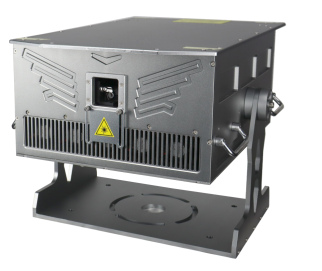
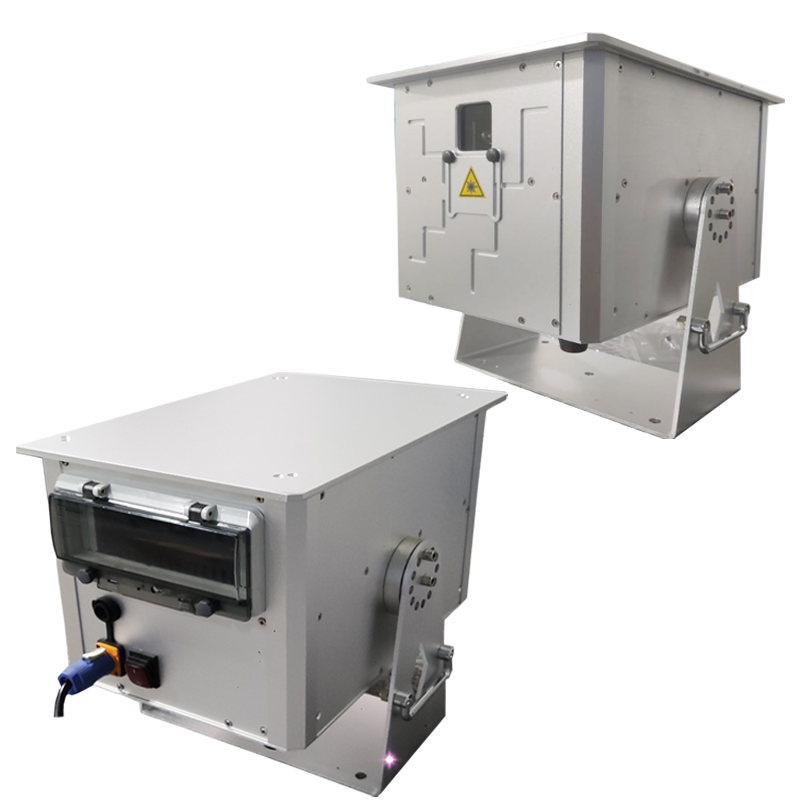
Outdoor landmark lasers
7 products
An outdoor landmark laser does one thing: it makes a beam visible kilometres away, planted on a landmark rather than washing a surface with light. That is a different job from laser lights (moving head), which sweeps a surface, and from waterproof laser starry lights, which spreads points. This page covers how to choose within the landmark line. Every figure is read from our own spec sheet and can be checked line by line.
1. The first number is range, not power
A landmark beam is judged by how far and how brightly it travels through the air, so the order is: measure the straight-line distance from the mounting point to the target position first, then choose the power tier. On our own spec sheet one tier on this line is rated for an indoor “laser range of about 60 metres”; outdoor landmark range has to be checked against actual atmospheric conditions — humidity, dust, temperature difference — and the spec sheet figure is only a baseline.
This is also the practical difference between a landmark light and a moving head: a moving head is chosen by area to be covered, a landmark light by straight-line distance. A model that does not reach far enough cannot be fixed later, so this step has to come before choosing power.
2. The wattage in the model name is laser output — the real draw is tens of times higher
This is the hardest reading on the line. On our own spec sheet, the 80W tier consumes 1200W, the 50–60W tier 1000W, and the 100–150W tier 1800W, while one 50W waterproof model states a rated fixture power of 1000W. The ratio falls between 12× and 20×.
The single-green models push it higher. On our own spec sheet the 30W single-green model states a rated fixture power of 2000W, where the 5–8W tier draws 200W and the 15W tier 300W. What actually draws that current is the laser pump, the power supply and the forced-air cooling — not the output power on the badge.
There is one conclusion: sizing the supply from the model name will trip the breaker; it has to be sized from the fixture-power row. One 30W single-green landmark unit is budgeted at 2 kW, two units at 4 kW, plus cable losses and starting margin. Quotes have to state whether the figure given is laser output or fixture draw.
3. How full-colour power is split across three channels
On our own spec sheet the full-colour landmark models state red, green and blue separately. The 50W tier is R-15W, G-15W, B-20W; the 60W tier is R-18W, G-17W, B-25W; the 80W tier is R-24W, G-30W, B-28W; the 100W tier is R-30W plus a combined green-blue module; and the 150W tier is R-40W plus that module.
Two points matter. First, the channels are not split evenly — blue normally gets the most and red the least. Second, from the 100W tier upward green and blue move to a combination module, so higher power is more heavily modularised. Both affect the image and the price; electrical sizing still comes from the single fixture-power row.
4. Beam quality: galvo, divergence, control interface
Whether a beam holds together is a question of divergence. On our own spec sheet the divergence angle across this line reads <1.2 mrad, with scan rates at 30K and 40K PPS and a 60° standard scan unit and driver circuit; one single-green model states a 50K galvo.
The smaller the divergence, the thinner and more line-like the beam at distance; a larger divergence reads as a fuzzy blob from far away. Landmark projects are therefore held to a tighter divergence than lighting projects, and this item should be confirmed on its own.
On the control side, our own spec sheet lists sound activation / auto / DMX512 / master-slave synchronisation with an ILDA interface for offline playback from laser control software. One waterproof model states 12 channels with over a hundred built-in beam and animation patterns and SD-card offline playback.
5. Three extra items outdoors
- Protection — our own spec sheet rates the outdoor models on this line to IP65 and notes waterproof, dust-proof, moisture-proof, corrosion-proof and rust-proof construction with a sealed system.
- Temperature — our own spec sheet gives −40°C to 40°C for the outdoor models with an internal thermostat that adjusts automatically, and another states −40°C to 45°C. Both cold starting in a northern winter and a hot cabinet in a southern summer have to be checked against the actual climate.
- Permissions and surroundings — a beam travels outwards and far, so approvals, airspace avoidance and surface reflection are verified by qualified professionals under local requirements; we do not issue conclusions on a site’s behalf. Rigging is sized for wind load, not static weight.
6. Choosing by venue
- City landmarks, towers, bridges — single green or high-power full colour; fix range before power, and the priority is a beam that does not spread plus long-term stability.
- Scenic areas and mountains — several units at fixed angles is steadier than one unit sweeping, and makes area management simpler.
- Water screens and lakes — water reflects, so siting and angle come first; no specification solves that for you.
- Events, openings, festivals — mid power with pattern variation; note that the fixture draw decides how many circuits have to be run.
To get a configuration
Send us the straight-line distance from the mounting point to the target, how many beams and in what colour, whether it is a permanent installation or an event, how much power the site can supply, the rigging or foundation conditions at the mounting point, and the local requirements for your city. That is enough to fix the tier, the fixture draw and the electrical plan.